
Analysis · A Generation Without a Chance
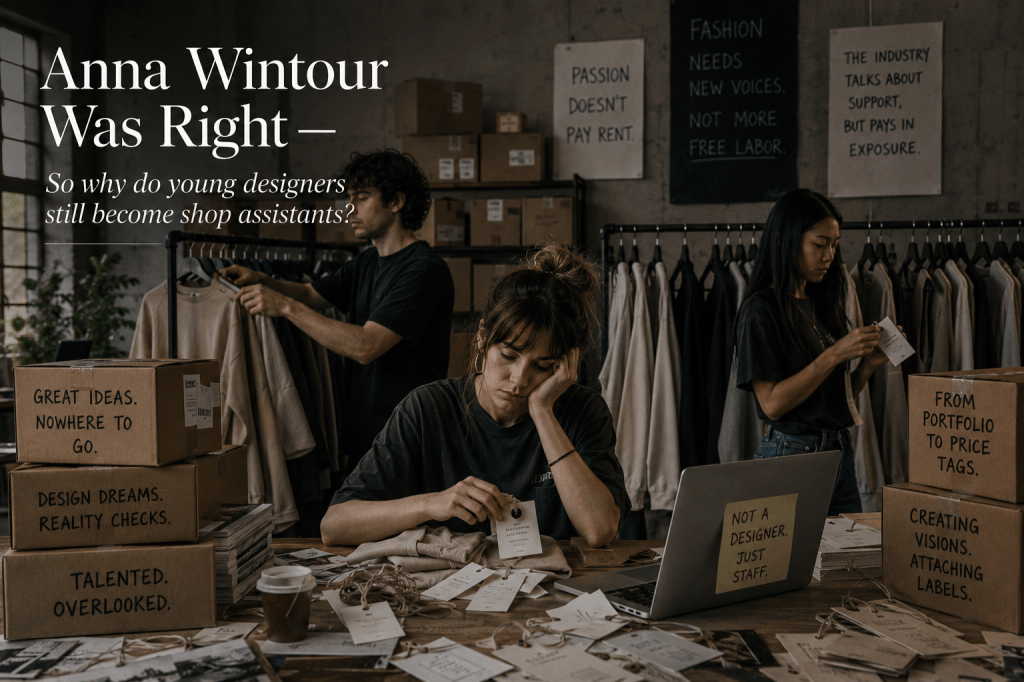
They enter fashion academies at 18, driven by a dream. They graduate at 22 with diplomas, portfolios and ideas. Five years later, most of them no longer work in fashion. And those who still do are selling clothes that someone else designed.
This is not a tragedy. It is the norm. And it is precisely that paradox which makes the case of Anna Wintour so important, and so painful.
There are few names in fashion as significant as Anna Wintour’s, editor-in-chief of American Vogue from 1988 to 2025. She did not merely chronicle the industry. She built parts of it, personally, by name.
After September 11th, 2001, when the industry was in free fall, Wintour went to the CFDA, the Council of Fashion Designers of America, with a concrete proposal. The winner of the CFDA/Vogue Fashion Fund receives $400,000. Two runners-up receive $150,000 each. But the most important part of the prize, in her own words, is the mentorship that comes with it. She created the fund not as charity but as an obligation, saying she felt it was her responsibility as an industry leader to ensure the future of American fashion.
The list of designers she helped personally is long and remarkable. On a flight from Miami to New York she was handed a note on a napkin by a young man she then helped into an internship at Michael Kors. He would go on to meet his partner at college, and together they founded Proenza Schouler. Years earlier in London she championed a young designer named John Galliano, drawn precisely to his originality and his point of view, and encouraged houses such as Christian Dior to bring in younger designers, Galliano among them.
“Nurture young talent, they are the future of fashion.” Anna Wintour
In 2014, at the inauguration of the Anna Wintour Costume Center at the Metropolitan Museum of Art, Michelle Obama described exactly what Wintour had been doing for decades. The fund, she said, was about lifting up brilliant young designers, not only with money but with mentorship and connections, everything they need to succeed and to dream bigger.
During the pandemic, Wintour took the next step and transformed the same fund into A Common Thread, an initiative to support designers struggling through the industry’s hardest moment.
In other words: if anyone has defended young designers, it is her.
And yet the pattern is unforgiving, and it repeats itself every year.
A young person graduates from Polimoda or Central Saint Martins. The graduation collection earns top marks. They begin an internship at an established brand, unpaid or nearly so. They become an assistant on a junior salary that in Milan rarely clears the high teens in thousands of euros before tax. After three years they realise they are not designing, they are servicing design. They try to launch their own label. They have no capital. They return to the industry, this time as a shop assistant. By 28, it is over.
I know dozens of them. Every one of them had real talent. Not dreams. Documented ability to make garments worth existing.
Which brings us to the uncomfortable question. Why did the greatest defender of young designers in fashion history fail to stop this?
The answer, however inconvenient, is this: one person, however powerful, cannot reverse a structural decision. What is happening to young designers is not a shortage of mentorship, funding or visibility. Wintour gave the industry exactly those three things, by name, consistently, for four decades. And still the doors kept closing.
Why? Not because someone sits in a boardroom and decides to destroy a generation. This is the result of structural decisions taken over thirty years.
Concentration of ownership. The industry was once made up of hundreds of independent houses, each in need of young designers. Today most of them belong to a handful of holding groups, where decisions are made by people managing quarterly financial reports rather than by people who love fashion. Even Wintour, with all her power at Vogue, could not change the logic of a corporate board.
The relocation of production. When the major brands moved production east, they did not only close European factories. They dismantled the infrastructure in which young designers grew up, shoulder to shoulder with master cutters, pattern-makers and tailors. With that infrastructure went the only way fashion is truly taught. Wintour herself insisted on this: go to school, learn the craft, then build a brand. But what remains when there is nowhere left to learn the craft?
The economics of fast fashion. Zara, H&M and Shein drove prices to a point where no small independent brand can exist. However refined a designer’s vision, it is not economically viable against a customer trained for two decades to expect a shirt for €9.99.
Lack of capital. Building a fashion brand today takes serious starting capital, commonly somewhere between a couple of hundred thousand euros and a million. Without family, an investor or a holding group behind you it is close to impossible. That is what has turned the industry into something hereditary: largely, only those born inside it ever get in.
Talent was never the problem. The problem is that the industry stopped having room for it.
When an entire generation of creators has nowhere to go, it is not only the generation that is lost. The industry goes with it. Yves Saint Laurent designed for Dior at 21. Karl Lagerfeld began at 22. Alexander McQueen made his first collection at 23. These names are not exceptions. They are the rule of an era in which fashion treated youth as its fuel.
How many genuinely new names have emerged in the past ten years? Names that changed the conversation, rather than being appointed creative director of an existing house? The list is troublingly short. Not because the generation lacks talent, but because the system has stopped cultivating it.
Wintour worked against this structure for years. She believed mentorship could overcome the absence of infrastructure. That funding could compensate for the absence of a market. That visibility could open doors the system had closed.
She was not wrong. She was simply working against something larger than a single fund, a single cover, a single Met Gala invitation. She was working against a complete structural transformation of the industry, and she kept the question alive long enough for the rest of us to take the next step. Her advice to designers was always to resist running scared, and not to be too preoccupied with what is safe and commercial.
At Cantarelli we do not accept this script. Not out of idealism, but because, as the third generation in this industry, we see clearly that the model is economically and creatively unsustainable. The alternative is not another competition. It is not an incubator. It is not another Instagram platform. The alternative is to bring the atelier back into fashion: a place where a designer does not work for a brand but builds a practice of their own. Not a global ambition with hundreds of SKUs, but an atelier making personalised wardrobes for specific clients.
This is not a luxury for the elite. It was the norm for every generation before ours. The men and women of the twentieth century had their own tailor or their own designer, not because they were wealthy, but because that was the structure of the market.
What Wintour achieved with mentorship, we want to continue with infrastructure. She opened doors. We want to build the buildings. Because mentorship can help ten designers a year. Structural change can help ten thousand.
To the young designers reading this: you are not a lost generation. You are the generation that can overturn the model, if you accept that there is no point waiting for the major brands to open doors that will never open. Anna Wintour showed us that help is possible. Now it is our turn to make it accessible.
Manifesto
Anna Wintour devoted her life to opening doors for young designers. She did everything one person can do. Now it is the turn of an entire generation to do what one person never can: change the structure of the industry itself. Talent left without a place does not disappear. It simply goes elsewhere. We intend to give it a place.

Leave a Reply