
Most people think marketing is about saying the right thing at the right time to the right person. Patagonia said the wrong thing. On purpose. And it changed everything.
The Story
It was Black Friday 2011. The biggest shopping day of the year. People were buying things they did not need, simply because they were on sale.
Every brand in the world was screaming the same three words: buy more, save more, get more.
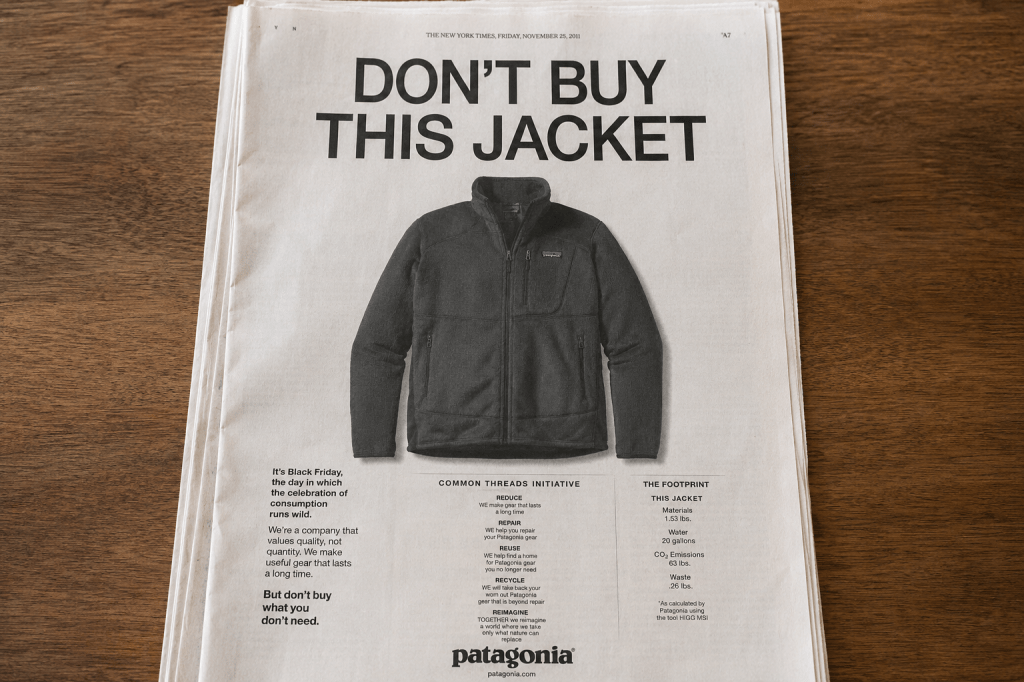
Patagonia took out a full-page ad in the New York Times. It showed one of their best-selling jackets. And underneath it, in big bold letters:
“Don’t Buy This Jacket.”
Not what you would expect from a company trying to sell things. They told their own customers not to buy their product. Then they went further and listed what making it had actually cost: the water used, the carbon emitted, the waste created. The argument underneath was simple. They make gear built to last a long time, and you should still not buy what you do not need.
This was not a shocking headline or a clever PR stunt. The campaign was part of a long-term programme called the Common Threads Initiative, built around one idea:
Buy less. Buy better. Keep things longer.
The internet lost its mind. Journalists called it career suicide. Marketing experts called it reckless. Competitors laughed. Why in a million years would you advertise your own disadvantages?
Then the business grew. Patagonia’s customer base did not shrink, it expanded. People who had never heard of the brand became loyal customers for life.
Not because of a discount. Not because of a campaign. Because Patagonia had the courage to say out loud what every other brand was afraid to admit.
They were honest. And in a world full of noise, honesty is one of the rarest and most powerful marketing tools there is.
Showing who you are. What you stand for. How your product is built. What it actually costs.
Transparent enough to build trust. That is why the campaign worked.
The Golden Rule
The founders who say what everyone else is afraid to say are the ones people remember.
Most founders hide behind safe messaging. Professional tone. Polished content. Perfect captions. They say what they think people want to hear, and people scroll right past it.
But when a founder says something real, vulnerable, honest, a statement that actually costs them something to say, people stop.
They react. They share it. Some of them hate it. They remember it. And, most importantly, they trust it.
Patagonia did not win because they had the best jacket. They won because they had the courage to talk openly about the real cost of making it.
They started a conversation nobody else was willing to have: overconsumption.
Your customers do not need you to be perfect. They need you to be real, and to show them the problem your product actually solves.
The question isn’t “what should I post today?”
The question is “what am I afraid to say, and why?”
Mikaela

Leave a Reply