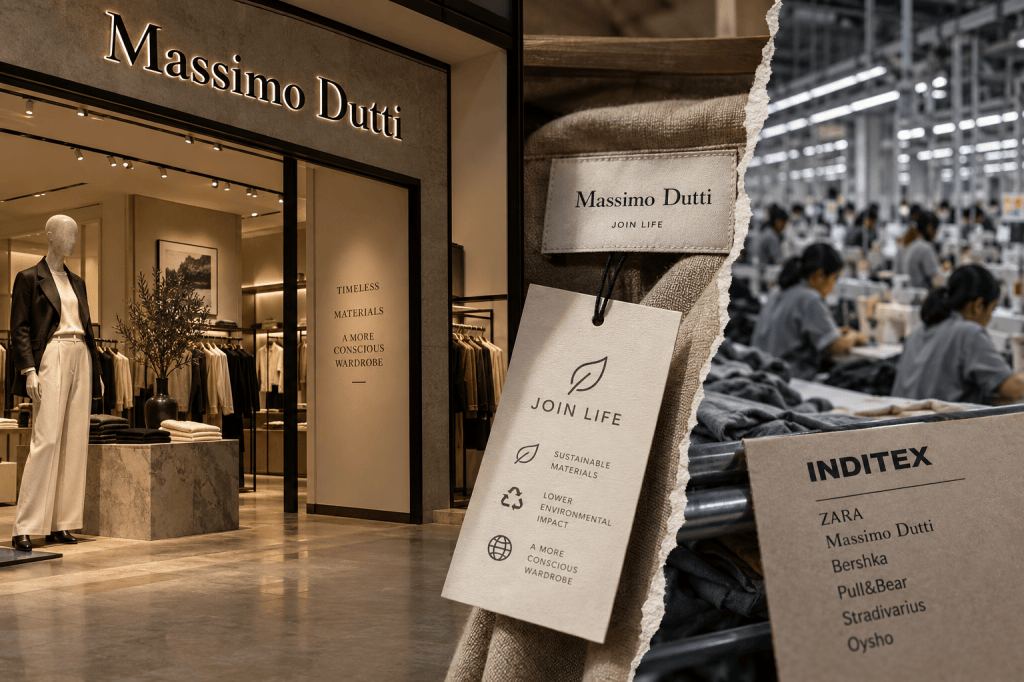
Walk into a Massimo Dutti store and the signals are all there. Heavier hangers. Muted lighting. Linen and wool draped like a boutique atelier. Prices roughly double what you would pay next door at Zara. The brand presents itself as the considered older sibling in the Inditex family: timeless rather than trendy, quality rather than quantity.
Strip away the styling and one question remains. Is Massimo Dutti a different kind of company, or is it Zara’s business model wearing a better coat?
Same owner, same machine
Massimo Dutti is not an independent house that Inditex happens to own. It is fully integrated into the group’s production logic. Inditex runs on near-vertical integration, with roughly half of its manufacturing close to headquarters across Spain, Portugal, Morocco and Turkey, alongside factories further afield. Massimo Dutti draws from that same supplier pool rather than running a separate, artisanal production line.
In 2021 Inditex folded its premium accessories brand Uterqüe directly into Massimo Dutti, absorbing its product ranges and lifestyle positioning. That is a branding upgrade engineered from the top, not a change in who is stitching the garments. The brand now runs several hundred stores across dozens of countries on the identical logistics and buying infrastructure as Zara, Bershka and Pull&Bear.
What the label doesn’t say loudly enough
On disclosure, Massimo Dutti does better than many fast-fashion peers on paper. It operates under a Global Framework Agreement with a trade union, it publishes its supplier factories, and its Fashion Transparency Index score climbed from the 41 to 50 per cent band in 2020 into the 81 to 90 per cent band by 2022.
But transparency about who makes the clothes is not proof of how well those workers are treated. The Business & Human Rights Resource Centre notes there is no public evidence that the brand’s suppliers pay a living wage. Knowing the address of a factory tells you where to look. It does not tell you what you would find.
The materials tell a similar story. The Join Life line is presented as the brand’s sustainable face, but independent reviewers find most of what the company actually uses is either uncertified conventional cotton and linen or petroleum-based synthetics: polyester, nylon, acrylic. Lower-impact fibres such as Tencel, modal and recycled polyester make up a small share of the total. Good On You rates the brand as using a medium proportion of lower-impact materials, and flags that its target to eliminate hazardous chemicals comes with no evidence it is on track.
The most telling number is the gap. Inditex set a group-wide goal of 100 per cent more sustainable materials by 2025. Massimo Dutti’s actual usage sits at roughly 20 to 25 per cent. That is not a rounding error. It is the distance between a commitment and a collection.
The manipulation is in the gap itself
Here is the mechanism, named plainly. A sustainable capsule inside an otherwise conventional collection lets a brand borrow the halo of the entire ethical-fashion movement while changing very little about its actual sourcing. The customer sees a Join Life tag, infers that the whole brand, and the higher price, must be more responsible and more durable, and buys accordingly. In reality they are often paying a premium for perceived exclusivity and heavier fabric weight, not for a fundamentally different supply chain.
This is common enough to be structural. One review of sustainability claims across the textile, garment and footwear sector found that up to 39 per cent of them may be inaccurate or exaggerated.
Regulation is closing the loophole
The timing here is not incidental. The EU’s textile strategy is arriving with teeth: an Ecodesign Regulation setting durability and recyclability minimums, a Digital Product Passport disclosing material composition and origin, and, most relevant to greenwashing, the Empowering Consumers for the Green Transition Directive, which bans vague, unsubstantiated claims such as eco-friendly and sustainability labels not backed by an approved certification scheme. Member states had to transpose it by March 2026, with enforcement from September 2026. Essentially now.
Seen against that backdrop, Massimo Dutti’s climb upmarket reads less like coincidence and more like preparation. A brand already positioned as considered and quality-led, already collecting transparency points, already running a labelled sustainable capsule, is far better placed to absorb new labelling and disclosure rules than one built entirely on speed and disposability. Whether that is foresight or good luck is impossible to prove from outside the building.
Luxury ambition, profit strategy, or both?
The honest answer is not either/or. Massimo Dutti lets Inditex capture a customer who has aged out of Zara, or who wants to feel they are buying better without paying true luxury prices. That is a straightforward profit play, extending the group’s reach into a mid-premium segment it did not previously own outright. It is also a hedge against a regulatory horizon in which fast fashion becomes a commercial liability and unverified green claims become a legal one. The branding does both jobs at once, which is exactly why it deserves scrutiny rather than the benefit of the doubt.
And underneath both motives sits the thing neither addresses. The volumes have not changed. A heavier linen shirt produced on the same forecast, in the same quantity, through the same supplier pool, carries the same structural waste as the lighter one sold next door. Better fabric on an unchanged business model is a better garment, and that is worth something. It is not a different company.
The test is not what the capsule says. It is what happens to the ninety per cent of the collection that carries no tag at all.

Leave a Reply