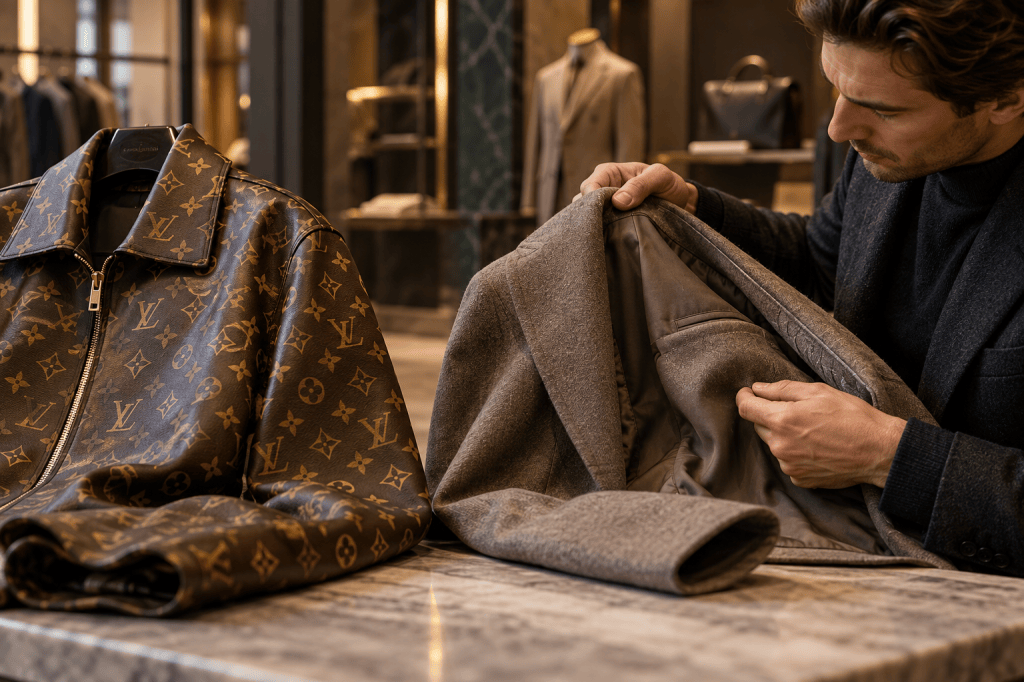
I have watched the same moment happen in fitting rooms for years. A client picks up a jacket, turns it over, scans the chest for something. Not finding it, they ask the question that used to make perfect sense: how will anyone know what this is?
What has changed is how fast that question is disappearing. More often now, the client turns the jacket inside out instead. Looks at the seam. Rubs the cloth between two fingers. And stops asking.
Being branded from head to toe is on its way out. Not because a committee of stylists decided so, but because the people paying for it finally worked out what they were buying.
Where logomania actually came from
Logomania has a birthplace and an author, and neither is European. In 1982, Daniel Day, known as Dapper Dan, opened a boutique on 125th Street in Harlem that stayed open around the clock, and started screen-printing Gucci, Fendi, Louis Vuitton and MCM motifs across leather, fur and tracksuits for rappers, boxers and anyone else the luxury houses were not interested in serving. He called the results knock-ups rather than knock-offs, because he was not copying products. He was sampling marks, the way producers were sampling records a few blocks away.
The houses themselves had always used their marks as punctuation: a clasp, a lining, a small stamp on a corner. Dan scaled them up until the monogram was the entire surface of the garment.
Fendi raided the boutique in 1988. By 1992, legal pressure had closed it. Five years later Marc Jacobs arrived at Louis Vuitton and began doing institutionally, with lawyers and a marketing budget, exactly what Dan had been doing alone on 125th Street. The nineties became peak logomania: the double F on bags, on luggage, on prams. In 2017 Gucci sent out a balloon-sleeved bomber that looked remarkably like one Dan had made for the Olympian Diane Dixon three decades earlier. After the outcry, the house hired him and funded a new store.
This history matters, because it explains the decay. Logomania began as self-assertion by people who had been shut out. It ended as a licensing strategy. Somewhere in between, the meaning was drained out of it and what remained was a surcharge.
What a big logo signals, and who it signals to
The most useful thing ever written on this is not a trend report. It is a 2010 study in the Journal of Marketing by Young Jee Han, Joseph Nunes and Xavier Drèze, which introduced the idea of brand prominence, meaning how conspicuous a mark is on a product, and then did the unglamorous work of checking what it buys you.
Their findings are worth carrying around in your head. Wealthy buyers with no particular need for status pay more for quiet goods that only their own kind can identify. Wealthy buyers who do crave status use loud goods to signal to everyone else that they are not one of them. Those who want the status and cannot afford the goods buy loud counterfeits. And so the houses price accordingly: within the same range, the quieter piece carries the higher price, sometimes by hundreds of dollars, on branding alone.
Read that again, because it inverts the instinct completely. The piece shouting the name is, more often than not, the cheap end of the collection. The loud logo is the entry ticket, not the destination.
And then there is the counterfeit problem
The same study found that counterfeiters concentrate almost entirely on the loud, lower-priced pieces and largely ignore the quiet ones. Fifteen years on, the authentication data says the same thing: in Entrupy’s most recent counterfeiting report, Louis Vuitton accounted for roughly a third of all flagged luxury submissions, with the monogram canvas among the most replicated surfaces in the market.
This is the part clients have understood on their own, without any help from us. A prominent logo is the single most efficient way to make your own garment ambiguous. Anybody looking at it is no longer asking whether it is good. They are asking whether it is real.
The market has already voted
Gucci spent the last decade as the loudest house in luxury, and the numbers since have been brutal. Revenue fell from more than €10 billion in 2022 to around €6 billion in 2025, a 22 per cent drop in that year alone, with a further 14.3 per cent fall in the first quarter of 2026. Kering’s group revenue came in at €14.7 billion for 2025, down 13 per cent. Over the same stretch Bottega Veneta, the house that has never put its name on the outside of a bag, finished the year flat and grew on a comparable basis. The bleeding has since slowed, and Kering returned to slight comparable growth in the first half of this year, but the shape of the decade is not in doubt.
I want to be honest about the counter-evidence, because it is real and it is being misread. Monograms are back on the 2026 menswear runways at Gucci, Louis Vuitton and Dior. Morgan Stanley has flagged consumer fatigue with minimalism. The Business of Fashion ran a piece this year arguing that logomania never died but evolved, with shoppers swapping the big houses’ monograms for small, niche, in-joke branding instead.
All of that is true, and none of it revives the thing we are talking about. What is returning is a mark as a small deliberate reference: one, on one piece, chosen. What is not returning is being upholstered in someone else’s trademark from collar to shoe. Those are opposite gestures wearing the same word.
Cloth that needs no caption
What has replaced the monogram, for the client who can afford to choose, is material.
Loro Piana built an entire empire on fibres most people cannot name: baby cashmere from the underfleece of young Hircus goats, vicuña from the Peruvian Andes, the ultra-fine merino it sells as The Gift of Kings. Its Summer Walk loafer carries no visible branding at all and has become one of the most instantly placed shoes in the world, among the people who place it.
The Spring 2026 runways made the shift literal. The season was obsessed with texture: pebbled leathers, oversized woven leather, hand-worked embroidery. The current visual shorthand for luxury is not a name. It is evidence of making, a surface that shows how it was made and how long it took.
The resale market has confirmed the logic in the only language the industry respects. Pre-owned is now growing roughly three times faster than the primary market, and Deloitte reports that 68 per cent of luxury fashion companies offer repair or refurbishment and 54 per cent run certified pre-owned programmes. Once a garment has a second life, it is judged on construction and condition. Nobody resells a logo. They resell a cloth and a seam.
Recognisable if you know, invisible if you don’t
Here is the part most people miss. The logo did not disappear. It moved into the construction.
Bottega Veneta has advertised since the 1970s under the line when your own initials are enough, and has kept its wordmark on interior labels, dust bags and packaging, never on the outside of a leather good. In its place is the intrecciato: strips of leather woven by hand, originally a technical fix to make thin hide strong enough to sew, now one of the four or five most identifiable marks in fashion. A signature written in leather rather than printed in gold.
That is the model now, and it is spreading: a shoulder line, a sole construction, a lapel roll, a buttonhole, a weave, a colour that belongs to one mill. Codes legible to anyone who has handled enough garments, and completely invisible to anyone who has not.
And here is why it is structurally stronger than a printed mark: these codes have to be made. A monogram can be reproduced by anyone with a print room and a canvas supplier. A hand-woven panel, a hand-padded chest, a properly set sleeve: those require the skill itself. This is precisely why the counterfeit market swarms printed logos and leaves the quiet houses comparatively alone. The quality is the security feature.
Why this carries more image, not less
Four things happen when you stop wearing the name.
You become the subject again. A branded garment introduces the house first and you second. Remove the mark and people read the fit, the posture, the colour, the person. That is a better first impression than a trademark, every time.
It ages on your side. A logo dates a garment to the marketing cycle that produced it. Anyone can place a monogram print within a season or two. Good cloth and clean construction have no timestamp. They simply get better as they soften.
Your money goes into the object. When you buy the mark, a meaningful share of the price is buying campaigns, licensing and shelf recognition. When you buy the cloth and the make, the money is in the thing itself, which is also the part that survives ten years of wear.
It cannot be faked cheaply. Anyone can imitate a logo for twenty euros. Nobody can imitate a properly constructed shoulder at any price, because the imitation would cost what the original costs.
There is an ethical dimension to this that rarely gets said out loud. Logo-led fashion runs on volume. The mark is the product, so the incentive is to print it onto as many units as possible and hope the sell-through holds. That is the machinery of overproduction. It also feeds a counterfeit industry churning out synthetic pieces with short lives, no resale route and no recycling path. A garment judged on its material has the opposite incentive: make fewer, make them properly, sell them at a price that reflects what went in.
The only test that matters
Strip every name off a garment and ask whether anyone would still want it.
If the answer is yes, you are holding something worth owning. If the answer is no, you were never buying clothing. You were renting someone else’s advertising space, and paying for the privilege.
The clients have worked this out. The industry is catching up.

Leave a Reply