
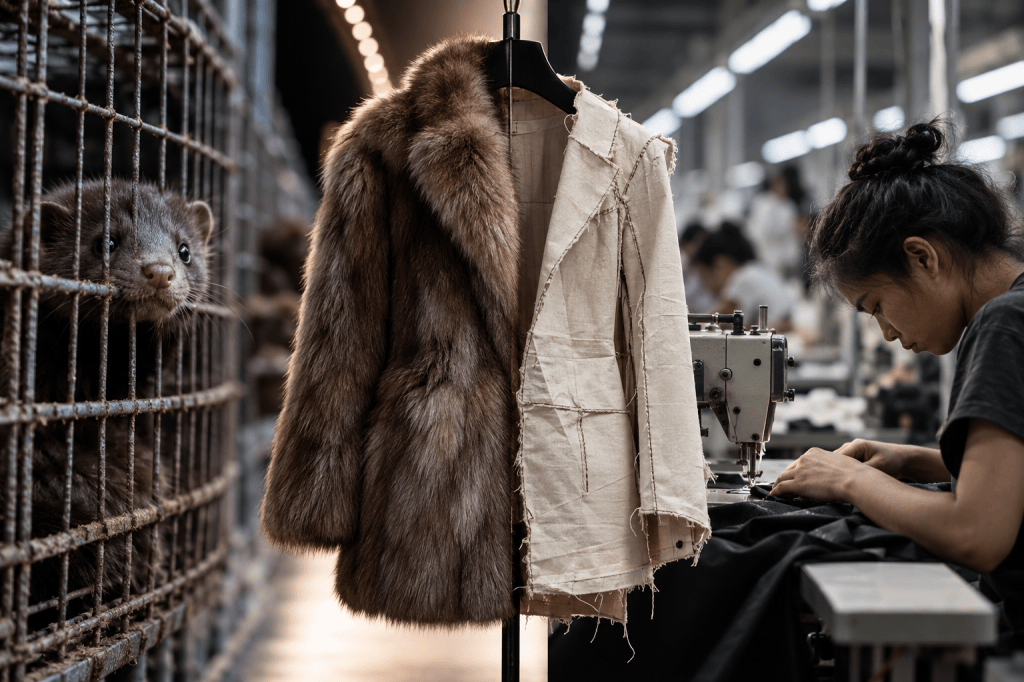
Every season, fashion hands us a new obsession: a silhouette, a fabric, a must-have, and asks us to forget what came before. What it rarely asks is who or what paid for it.
This September, New York’s runways went fur-free for the first time. It is a genuine milestone. But it also raises an uncomfortable question: if we can decide that an animal’s life is no longer an acceptable price for a coat, why has it taken so much longer to decide the same about a human one?
Two Cages, One Industry
Walk back far enough and fashion’s history splits into two parallel supply chains of sacrifice. One is visible, furred, easy to photograph and easy to protest: the mink farm, the trapline, the pelt auction. The other is quieter. A windowless floor in a garment district, a seamstress paid by the piece, a factory fire that makes headlines for three days and then does not.
Both economies run on the same logic. A life, animal or human, treated as a raw material whose suffering does not show up on the price tag. The industry has spent decades getting extremely good at making both invisible to the person holding the shopping bag.
The Trend Machine Needs a Victim
Trends are not accidents. They are manufactured scarcity, a deliberate cycle designed to make last season’s essential feel obsolete so this season’s can sell. That cycle only works if production stays fast and cheap. And fast, cheap production has always needed someone to absorb the cost that speed does not pay for: an animal bred purely to die, or a worker whose hours and wages are quietly compressed until the margin works.
The fur coat and the unpaid overtime are not separate stories. They are the same business model wearing two different faces.
What New York’s Fur Ban Actually Says
The Council of Fashion Designers of America announced the policy in December 2025, with Humane World for Animals and Collective Fashion Justice, and it took effect with the September 2026 shows. Animal fur is no longer permitted in collections on the Official NYFW Schedule, and it will not appear on the CFDA’s calendar, website or social channels either. The ban covers animals killed specifically for their pelts, mink, fox, rabbit, chinchilla, coyote, karakul lamb, raccoon dog, with an exemption for fur from Indigenous subsistence practices. New York joins London, which went fur-free in 2018, along with Copenhagen, Berlin, Stockholm, Amsterdam, Helsinki and Melbourne. Milan and Paris have not followed.
Steven Kolb, the CFDA’s chief executive, was candid about the scale of it: there was already little to no fur shown at New York, and the point of the position is to make designers think harder about the industry’s impact on animals. That honesty is worth more than a triumphal press release, and it tells you what the ban really is. Not a rupture. A ratification of something that had already happened commercially.
Note also what the ban does not cover. Leather and shearling are both outside it. So the line New York drew is not a line around animal death. It is a line around the particular form of animal death that consumers stopped tolerating.
That is not a reason to dismiss it. It proves something important: an industry built on “this is just how it’s done” can change its own rules when the pressure is loud enough and sustained enough. The question worth asking is why that same pressure has not yet forced an equally clear line on labour. There is no calendar rule excluding brands that rely on unaudited, underpaid piecework. There is a runway ban for the version of cruelty that is easiest to photograph, and none for the rest.
The Brands Rewriting Both Chapters
What is genuinely interesting is watching which brands are changing both stories at once: not only going fur-free, but restructuring how and where garments are made. Houses that abandoned fur years before it was fashionable to do so are, in several cases, the same ones now investing in traceable, standardised labour conditions rather than opaque subcontracting chains. That is not a coincidence. Once a brand starts asking what this actually cost, the question does not stay confined to the animal.
The reverse is also true, and worth watching. Brands that make loud fur-free announcements while saying nothing about who sewed the faux fur, or what that synthetic pile is made of, are doing half an audit and publishing it as a whole one.
The Voices We Don’t Hear
An animal in a cage cannot object. Neither, in practice, can a garment worker three subcontracting layers away from the brand whose label she is sewing in. Distance is the mechanism both systems rely on: geographic, financial and emotional distance between the person wearing the trend and the life it was built on.
Ethical fashion, at its core, is the refusal to let that distance do its job. It is the insistence that the true cost of a garment includes everything that happened before it reached the rack. Fur or thread, farm or factory floor.
No Trend Is Worth a Life
Here is the line worth holding onto. A trend, by definition, is temporary. A life, animal or human, is not. No aesthetic cycle, no seasonal it-piece, no scarcity marketing campaign justifies treating either as expendable.
Fashion has just proven it can retire an entire material in the name of conscience. The harder question is whether it can retire the mindset that made the material acceptable in the first place, the one that still, quietly, prices human labour the way it once priced fur: as a cost to be minimised, not a life to be respected.

Leave a Reply