
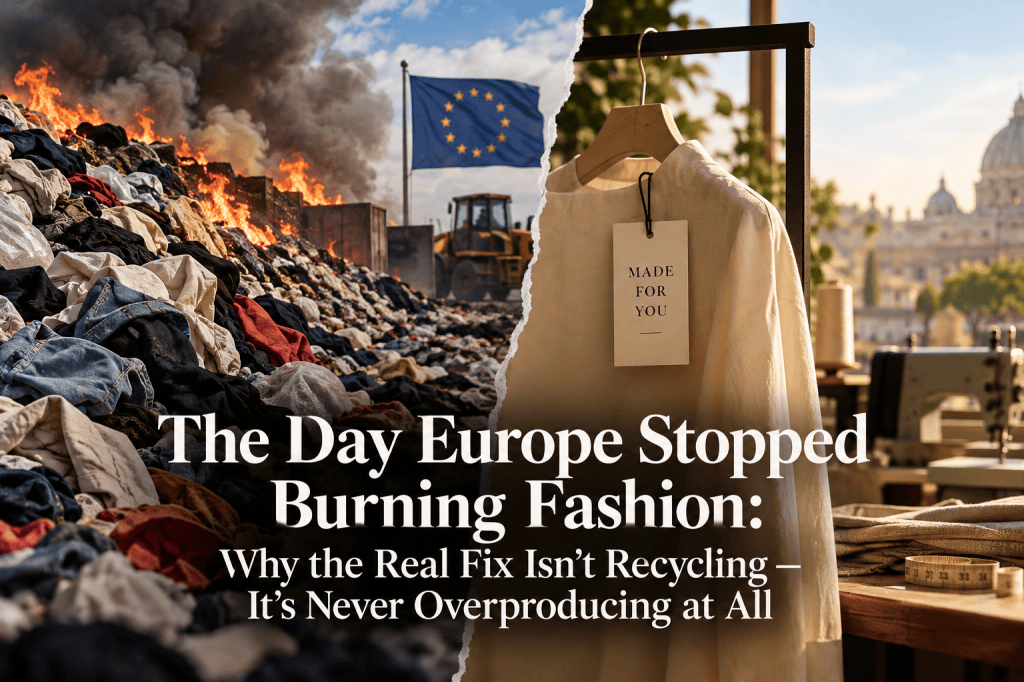
I have spent years writing about the gap between what fashion says and what fashion does. On 19 July 2026, that gap closed by law, at least for one specific, ugly practice: destroying clothes nobody bought.
Under the EU’s Ecodesign for Sustainable Products Regulation, large companies are now prohibited from destroying unsold apparel, footwear and accessories. Unsold stock has to be kept in use instead: sold, donated, repaired or repurposed. Destruction remains lawful only in narrow documented cases, such as goods that are unsafe, counterfeit, or that charities have refused, and a company relying on one of those must produce evidence, publish annual reports on what it discarded and keep records for five years. Medium-sized companies follow in 2030. Micro and small enterprises are outside it.
Here is my honest reaction to all of it. This law is solving the wrong end of the problem.
Banning destruction still assumes the destruction was inevitable, that a brand will always produce more than it sells and the only question is what happens to the leftovers. Donate them, recycle them, repurpose them, fine. But a dress that was never bought, however responsibly it is disposed of, is still a dress that consumed cotton, water, labour and energy for nothing. Compliance with this regulation can make overproduction less toxic. It cannot make it valuable.
The real fix sits one step earlier, in the business model itself. Fashion does not have to guess six months in advance how many size-38 navy coats the world will want, manufacture all of them at once to hit a minimum order quantity, and then hope. That entire structure, forecast, overproduce, discount, dispose, is the source of the waste this regulation is trying to manage after the fact. Made-to-measure and made-to-order production, built around short collections with fast, small-batch reloads and no minimum quantities, removes the problem at its root. If a garment is only cut once someone has actually chosen it, there is no surplus to donate, no unsold inventory to report, and no destruction question to answer, because the question never arises.
I want to be specific about why this is also the better business decision, not only the more ethical one. Overproduction is not only a waste problem. It is a pricing problem. A large part of a garment’s markup exists to cover the risk of stock that will not sell: six months of capital tied up in inventory built on a forecast, the unsold units, the markdowns, the margin lost to discounting. Take that risk out of the model and you take a real cost out of the price. A brand producing to order is not padding the price of every piece to subsidise the pieces nobody wanted. Every garment made is already sold, already valued, already destined for a wardrobe rather than a warehouse. That is a structurally different economics from the six-month buy.
I have said this before about other parts of the ethical fashion conversation, and I will say it again here. The production I know best was built on small-batch, made-to-order principles years before this law existed, not because a regulation was coming, but because a garment produced with intention, chosen and then made rather than made and then hoped for, is a garment designed to last. That is what value means to me in this context. Not price, but the fact that the piece was worth making in the first place.
So if you run a mid-sized brand looking at the 2030 deadline as breathing room, I would offer a different way to spend those years. Do not use them to build better disposal logistics for stock you should not have made. Use them to rebuild toward short collections, fast small-batch reloads, and production triggered by real demand instead of forecasts. By the time the law catches up to your size, you will not need it to change anything. You will already have nothing left to burn.

Leave a Reply