
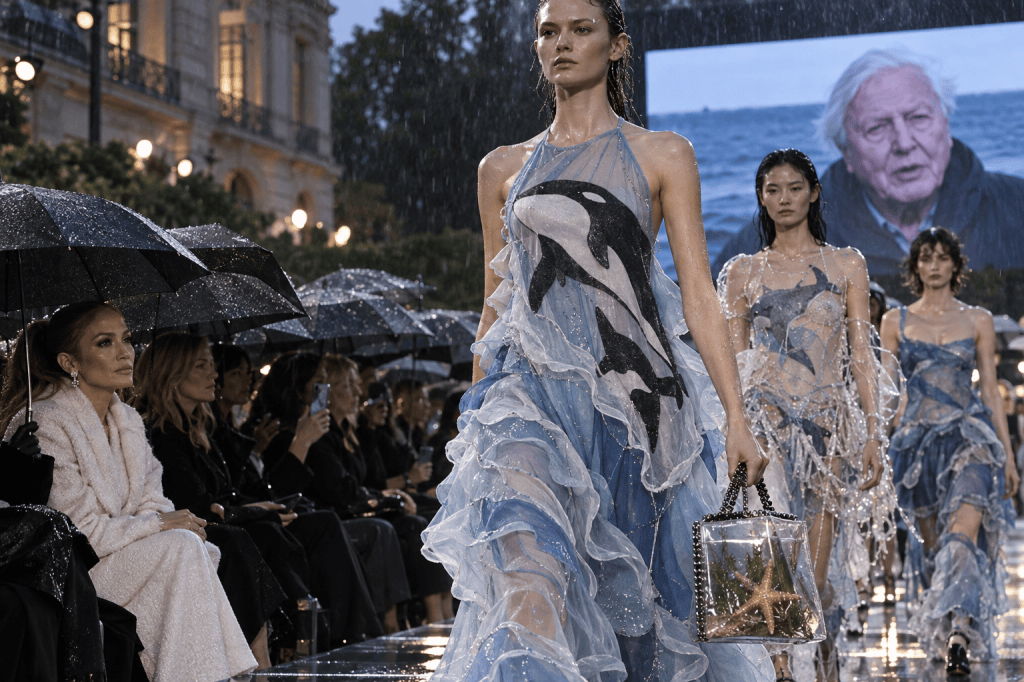
On the last day of September, in the garden of the British ambassador’s residence in Paris, David Attenborough’s recorded voice opened a fashion show by telling the audience that we have drained the life out of our ocean. Jennifer Lopez sat front row. And Stella McCartney, twenty-five years into a label that has never used leather, fur or feathers, spent the afternoon talking about fish.
Her argument started with vocabulary. The same animals are sea life when we admire them and seafood when we order them, and somebody decided which word applies. She wanted the audience to sit with that question, sea life or seafood, what’s my choice?, before they looked at a single dress. On the industry that fills the menu she was not subtle. Fishing is stealth, she said afterwards: “it’s war, we’re at war with the ocean.”
Then she turned around and told the luxury groups what they owe.
The ask nobody put in the headline
Most of the coverage stopped at the orcas. Fair enough: they were on the clothes, along with sharks and dolphins, and models carried transparent bags with starfish suspended inside them like specimen cases. The ocean shaped the construction too, in bubble hems, wave motifs worked across tops and dresses, and clear fishing line threaded into the knitwear. The denim was entirely recycled. It was a beautiful collection, and she would rather you said so than called it sustainable.
But the line that matters came afterwards, and Reuters caught it: McCartney called on the big luxury brands to invest in scaling up more sustainable materials, naming organic cotton and lab-grown wool. Speaking to reporters she went further and named names, criticising LVMH and Kering for not investing enough to replace oil-based polyester, thirsty cotton and animal materials.
That is not a vague appeal to do better. That is an invoice, addressed upward, from a designer who is no longer standing inside the building. She bought her brand back from LVMH at the start of 2025. She is now asking the conglomerates to fund the raw material pipelines she has spent two decades proving are possible, from outside them.
What “lab-grown wool” actually means
The phrase deserves unpacking, because the real material is more interesting than the shorthand suggests.
Since her Winter 2026 collection, McCartney has been knitting with Brewed Protein, a fibre made by the Japanese biotech firm Spiber. It is not wool grown in a dish. It is a structural protein fermented from plant-derived sugars, closer to brewing beer than to farming sheep, then spun into yarn that behaves like fine merino or cashmere. The two companies have been developing it together for more than four years, and those Winter 2026 knits used fibres measuring twelve to fourteen microns to get the hand she wanted.
The honest state of it
Almost everything on the market using this fibre is still a blend. Burberry’s B shield scarf, the first luxury product to carry it, is sixty-two per cent wool, eight per cent cashmere and thirty per cent Brewed Protein. Vollebak built an entire Lab-Grown capsule around the same material. Spiber has since gone further: working with the Italian mill Botto Giuseppe since 2023, it now has a worsted yarn made entirely of Brewed Protein, the first in Europe. That is real progress, and it is still a rounding error against what the global wool and cashmere trade moves in a year.
As for Spring 2027, there was no wool on that runway at all, and she said she was proud of it. Her leather alternatives come from mushrooms and from grape waste swept off vineyard floors. None of that needed a laboratory, and most of it needed only a decision.
The second ask, the one she made quietly
Six days before the show, McCartney co-founded The Climate Pledge Fashion Coalition alongside Amazon and the forest non-profit Canopy, with convening support from the World Economic Forum. More than sixty Climate Pledge signatories are in it, among them Selfridges, Brooks Running, Vestiaire Collective, Circ, Bananatex, Collina Strada and E.L.V Denim, all committed to net-zero carbon by 2040.
Read the launch materials and the operative word is not investment. It is demand. Members pool their purchases of lower-impact materials so suppliers can count on steady, committed orders. The World Economic Forum is helping design blended finance that pairs risk-tolerant capital with private investors. Canopy’s Next Gen Now programme vets which next-generation fibres are genuinely ready for commercial adoption. And a Lever Library, built with input from more than thirty brands and suppliers, tells a company where its own supply chain would gain most.
McCartney described the point of it as turning innovation into infrastructure. Nicole Rycroft, who founded Canopy, put it in colder terms: widen fashion’s fibre basket, and you cut sourcing risk and keep forests standing. This is procurement wearing a climate initiative’s coat, and that is the most encouraging thing about it.
Which of the two asks actually works
Here is my honest reading: the invoice to the conglomerates will get the coverage, and the coalition will get the results.
There is a stubborn loop at the centre of materials innovation. A supplier cannot bring the price of a next-generation fibre down until it is producing serious volume. A brand on ordinary margins will not pay the premium that exists while volume is low. So the fibre stays in pilot, the brand stays in conventional cotton, and somebody publishes a report about it.
Capital alone does not break that loop. You can fund a fermentation plant and watch it run at a quarter of capacity, because a factory does not need money nearly as much as it needs a year of confirmed orders. Luxury groups have no shortage of capital. What they have withheld is commitment: the purchase order that lets a supplier plan, and therefore price, like a real business. Asking Kering and LVMH to write cheques is asking for the easier thing.
The problem neither ask solves
Demand aggregation is the enterprise-scale version of a problem every small brand already knows intimately: the minimum order quantity. A mill will not run a next-generation fibre for two hundred metres. It will run it for twenty thousand. Which means the designers most willing to work this way, the small houses, the made-to-order labels, the emerging names whose entire ethic is refusing to make what nobody ordered, are structurally locked out of the materials built for them.
And the industry’s standard workaround is the thing that broke fashion in the first place. A brand that needs five hundred units and must buy five thousand to clear the minimum has just manufactured four and a half thousand units of future markdown, future outlet stock, future landfill. We have spent two decades calling that sustainability because the fibre carried a certificate.
A coalition pooling sixty order books solves the volume problem for sixty companies. Conglomerate money solves it for the houses the conglomerates own. Neither does anything for the thousands below them. The only model that resolves the contradiction rather than financing it is one where you produce what has actually been sold: short collections, fast small-batch reloads, no minimum order at all. That is not a materials breakthrough. It is a business model, and it is available now, without anybody’s investment.
What to watch
The coalition has published a structure, a vetting process and a library. It has not published volume commitments: how many tonnes, by when, from whom. Until those numbers exist it remains an extremely well-convened promise, and fashion keeps a long shelf of those. The luxury groups, for their part, have said nothing in response to being handed the bill.
But she asked in public, with the industry’s cameras on her, which is harder to ignore than a letter. She closed her show notes with the philosopher Porphyry, on how we kill for luxury and then call it justice. And the question she opened with applies in both directions. Sea life or seafood is a choice somebody makes. So is organic cotton or conventional, committed order or speculative one, made because it sold or made because the mill demanded five thousand.
It is always somebody deciding. That was the whole point of the fish.
For more reporting on material innovation, supply chain transparency and the business models behind ethical fashion, subscribe to the Ethical Editorial newsletter.

Leave a Reply