
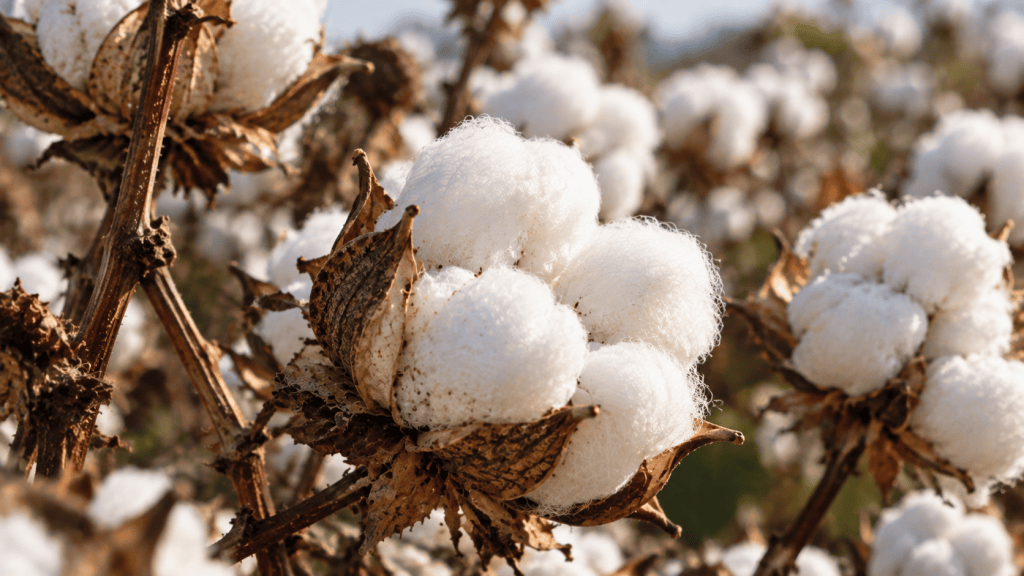
There is a sentence I hear in almost every sourcing conversation, always said with complete confidence: it’s fine, it’s 100% cotton. Natural fibre. Breathable. Grown in a field. Not petroleum. Whatever is wrong with fashion, surely it isn’t the cotton.
I have believed in natural materials my whole working life, and I still do. That is exactly why cotton deserves an honest accounting rather than a compliment.
Start with the label. “100% cotton” tells you one thing only: what the fibre is made of. It does not tell you how the plant was grown, who was exposed to which chemicals while growing it, how much freshwater it drank, or what was poured into the fabric after the harvest. The word natural has been doing an enormous amount of unpaid marketing work.
Why Ordinary Cotton Is a Chemical Crop
Cotton is a delicate plant usually grown in hot, dry, pest-heavy places. Insects love it. Left undefended, much of the crop is lost. So it is defended with chemistry: insecticides against the bugs, herbicides against the weeds, synthetic fertiliser to push the yield.
How much chemistry? On International Cotton Advisory Committee figures cited by Pesticide Action Network UK, cotton grows on roughly 2.4 per cent of the world’s farmland but accounts for about 4.7 per cent of all pesticides used and around 10 per cent of all insecticides. Roughly four times its fair share of the insect-killing chemicals.
You may have heard a much bigger number, that cotton swallows a quarter of the world’s insecticides. That figure is decades old and no longer accurate. Cotton Incorporated, the industry’s own research body, now puts the crop below 4 per cent of global pesticide sales. If we want to be believed, we have to stop repeating statistics that have expired.
The part that matters more than the percentage
The share of global pesticides is not really the story. The story is who absorbs it.
Most of the world’s cotton is grown by smallholders, families farming a few hectares. Pesticide Action Network UK estimates they can spend up to 60 per cent of their annual income on agrochemicals, usually bought on credit before the harvest that is supposed to pay for them. If the season goes badly, the debt does not. A single bad harvest does not produce a bad quarter. It produces a ruined family.
The chemicals are handled by people, often without proper protective equipment, in heat, by hand. This is the part that should matter most to anyone who uses the word ethical. The damage from conventional cotton is not abstract or atmospheric. It lands on the body of the person holding the sprayer.
What “Organic Cotton” Actually Means
Before we judge it, let us be precise about what the word buys.
Organic cotton is grown without synthetic pesticides, without synthetic fertilisers and without genetically modified seed. Pests are managed with crop rotation, natural predators and physical methods instead. Land does not qualify immediately: a field typically needs around three years clear of prohibited chemicals before its cotton can be sold as organic.
Two things follow from that definition, and both matter.
The first is that organic is a rule about farming. It is not a rule about the factory, the dye house or the finished garment. Hold on to that. We will come back to it, with numbers.
The second is that organic farms produce less cotton per hectare, typically somewhere around 60 to 80 per cent of conventional yields. That is the honest trade-off: cleaner fields, but more land for the same tonne of fibre.
The 91% Water Claim, and Why It Isn’t True
Here is where I part company with much of my own industry, including people I otherwise agree with.
You have read the statistic a thousand times: organic cotton uses 91% less water. It comes from a 2014 study by Textile Exchange, the non-profit that publishes the industry’s fibre data. The same study reported 46 per cent lower greenhouse gas emissions and 62 per cent lower energy use. Those three numbers have been printed on hangtags, investor decks and sustainability reports for over a decade.
To see the problem you need one piece of vocabulary. Water in farming comes in two kinds. Green water is rain that falls on the field. Blue water is freshwater pumped out of rivers, lakes and aquifers to irrigate. Rain is effectively free and local. Irrigation is what drains reservoirs and dries up rivers, so irrigation is the number that counts.
Now the problem. In 2021 the Transformers Foundation traced where the 91 per cent came from and found it had compared rain-fed organic cotton with irrigated conventional cotton. Two different places with two different rainfall patterns. The comparison was measuring geography, not farming method. The two underlying assessments had been peer reviewed. The comparison drawn between them had not.
Textile Exchange has since clarified that the figure holds only within the context of those two specific studies and should not be turned into a general claim. The newer data goes further. Carbonfact, analysing the cotton life-cycle assessment Textile Exchange published in March 2026, concludes flatly that organic cotton does not necessarily use less water than conventional, because water impact is driven by geography rather than by farming method. Textile Exchange itself now cautions that its figures carry real uncertainty, particularly around organic yields and irrigation water, and are meant for spotting problem areas rather than for head-to-head scoring between farming systems.
Organic cotton’s real case is toxicity, soil and farmer health. The water claim was always the weakest argument in the room, and the industry chose it because it was the easiest one to print.
Where Organic Genuinely Wins
None of that makes organic cotton a con. It makes one of its selling points a bad argument. The good arguments are elsewhere, and they are strong.
Chemicals and the people near them. This is the clearest win and needs no statistical argument at all. No synthetic pesticides means no pesticide exposure for the family in the field, no runoff into their drinking water, and no annual chemical debt. That alone is worth the premium.
Soil. Crop rotation and organic matter build soil that holds water and carbon instead of eroding. A field farmed this way is still a field in thirty years.
Carbon, where the evidence is improving fast. Synthetic nitrogen fertiliser is one of farming’s biggest climate costs, and organic systems do not use it. Textile Exchange’s 2026 cotton assessment identified field emissions, driven largely by nitrogen balance from synthetic fertiliser, as the primary hotspot across most systems and countries. A farm-level study of organic cotton in India carried out by the Organic Cotton Accelerator with South Pole found organic systems producing substantially lower greenhouse gas emissions than conventional irrigated cotton, and the 2026 datasets revised the footprint of Indian organic cotton sharply downward after long-flagged data problems were corrected.
So the honest summary is this: organic cotton is clearly better on chemicals, soil and farmer health, probably better on carbon, and roughly neutral on water depending entirely on where it grew.
After the Harvest: the Stage Almost Nobody Talks About
A cotton boll does not become a shirt by itself. Between the field and the shop there is a stage the industry calls wet processing, and it is where most of cotton’s water and chemistry is actually spent.
Here is roughly what happens to the cloth, in order. Desizing strips out the starch added to protect the yarn during weaving. Scouring boils the fabric in caustic soda to remove cotton’s natural waxes and pectins, because raw cotton repels water and will not take dye. Bleaching, usually with hydrogen peroxide, removes the natural beige colour. Mercerising, an optional step for lustre and dye uptake, soaks the cotton in concentrated caustic soda. Dyeing follows, hot, with dye plus large quantities of salt and alkali to drive colour into the fibre. Then repeated washing, and finally finishing: softeners, anti-wrinkle resins, water-repellent treatments.
Every one of those steps needs water, heat and chemistry. So how much?
The water: about 136 litres per kilo of fabric
A peer-reviewed survey of eighteen textile wet-processing factories in Bangladesh, published in PLOS Sustainability and Transformation in 2023, measured this rather than estimating it. The findings:
- 164 litres of groundwater extracted per kilogram of textile processed, on average.
- 136 litres per kilogram actually used in the dye house.
- 119 litres per kilogram leaving again as wastewater.
- The spread between factories was enormous: from 28 litres per kilo in an efficient denim operation to 285 litres per kilo in a knitwear mill.
Put that in garment terms. A cotton T-shirt holds roughly 200 grams of fabric, so at the study’s average that is something like 27 litres of water for the wet processing of one T-shirt, and about 33 litres pulled from the ground to deliver it. That is arithmetic from the per-kilo figures rather than a measured garment footprint, and it excludes everything the plant drank in the field. But it comes from measured factories, which is more than can be said for most water statistics in circulation.
Note the range, because it carries the lesson. A factory at 28 litres and a factory at 285 litres are both making cotton fabric. Which end your supplier sits at is a question about equipment and management. Not about the fibre, and not about any certificate on the cotton.
The chemicals: nearly half a kilo for every kilo of cloth
The same study measured chemical inputs, and this is the figure that stops people in a sourcing meeting: an average of 449 grams of chemicals per kilogram of textile, ranging from 152 to 705 grams across the factories, with annual totals running from roughly 950 to 4,500 tonnes per factory.
Most of that weight is not exotic. It is salt. Glauber salt averaged 254 grams per kilo of fabric and common salt another 71 grams, because reactive dyes, the standard choice for cotton, need high salt concentrations to push colour onto the fibre. Salt is not poisonous. But discharged in these volumes it makes effluent saline, and saline water damages freshwater ecosystems, irrigation and soil. It is also difficult and expensive to remove at a treatment plant.
Then there is the dye that never arrives. With reactive dyeing, the literature puts the share of dye that fails to fix to the fibre at 10 to 40 per cent. That unfixed dye washes straight out with the rinse water. It is why the rivers downstream of dyeing districts run the colour of the season.
Which substances actually worry regulators
Certain azo dyes. Azo dyes are the largest dye family in textiles. Most are unremarkable, but some break down to release aromatic amines classified as carcinogenic. The EU restricts these under REACH Annex XVII, entry 43: textile and leather articles in prolonged contact with skin may not release the listed amines above 30 milligrams per kilogram. Benzidine-based dyes, once used for bright shades, still surface in imported goods.
Formaldehyde resins. These deliver easy-care, non-iron and shrink-resistant finishes. Formaldehyde is a recognised carcinogen and a skin sensitiser. REACH Annex XVII entry 72 has capped it at 75 milligrams per kilogram in clothing, textile accessories and footwear that touch the skin since 2021, and from 6 August 2026 a separate restriction limits formaldehyde released into indoor air by articles such as curtains, upholstery and carpets.
Chromium (VI). Used in some dyeing and tanning processes to fix colour. Carcinogenic and a potent allergen.
Water-repellent finishes. Durable water repellency has conventionally relied on fluorinated chemistry, the PFAS family, which persists in the environment almost indefinitely and is now under rapid regulatory pressure in Europe.
Beyond named substances there is the plain physical cost: wet processing runs hot. Heating that much water, repeatedly, is why dye houses burn gas around the clock, and it is a large part of a cotton garment’s carbon footprint long after the farm has had its say.
And here is the uncomfortable conclusion
An organic farming certificate covers none of this. Not one litre, not one gram.
Cotton grown without a single synthetic pesticide can be scoured in caustic soda, bleached, dyed with 300 grams of salt per kilo, resin-finished with formaldehyde and rinsed into an untreated river, and it is still, accurately and legally, organic cotton. The farm is one chapter of a book with many chapters, and for most garments it is not the chapter where the damage is concentrated.
When the Certificate Itself Is Fake
Organic is only about 1 to 2 per cent of the world’s cotton. Textile Exchange’s latest Materials Market Report puts global cotton production at around 24.5 million tonnes, roughly 19 per cent of all textile fibre, and organic accounts for a few hundred thousand tonnes of that, with India supplying around half.
A scarce product that sells at a premium and comes mostly from one country is an obvious target for fraud. The fraud arrived.
In October 2020 the Global Organic Textile Standard, GOTS, the main certification body for organic textiles, uncovered around 20,000 tonnes of cotton in India that had been wrongly certified as organic. The method was forged paperwork: fake transaction certificates carrying QR codes that led to a cloned copy of the Indian government’s own certification website. GOTS banned eleven companies and cut its contract with one of its approved auditors. It was not a one-off. In 2024 it banned five more Indian firms for two years over fabricated certificates and fictitious shipping companies.
GOTS responded by verifying every incoming certificate itself rather than trusting national systems. That is the right fix, and also an admission of how thin the verification had been.
What to Ask For Instead
Ask for GOTS on the finished product, not “organic cotton” on the fibre
This is the single most useful sentence in the article, and everything above about wet processing is the reason why. GOTS requires at least 95 per cent certified organic fibre for its full organic grade, and unlike a farm certificate it governs the processing chain too: which chemicals may be used, how wastewater is treated, and what conditions workers labour under, all the way to the finished garment. A supplier saying “we use organic cotton” and a supplier handing you a GOTS certificate for the product are not making the same claim.
Ask the dye house for its litres per kilo
It is a standard operational metric, so a well-run mill will know it immediately. A figure near the bottom of that 28-to-285 range tells you more about real environmental performance than any hangtag. Ask what happens to the wastewater too, whether it is treated on site, and to what standard.
Ask where it was grown, not only whether it was certified
Since water impact in the field depends on region and irrigation method, the growing region tells you more than a certificate number does. Rain-fed origin is a real answer. And a supplier who cannot tell you where the cotton grew does not know their own supply chain.
Ask for the certificates, and verify them at the source
After 2020, nobody in this industry has an excuse for accepting a PDF at face value. Check it directly with the body that issued it.
The Fibre Is Not the Problem. The Volume Is.
Picture a brand that switches its entire range to certified organic cotton and prints the figures on every hangtag. It then produces three hundred thousand units of a garment that gets marked down 70 per cent in August and shredded in November.
Run the arithmetic on that. Three hundred thousand T-shirts is around 60 tonnes of fabric: on the measured averages, roughly 8 million litres of water and 27 tonnes of chemicals, most of it spent on garments nobody bought. The certificate improved the footprint of each kilo. The quantity was the entire problem. Multiply a slightly smaller number by a vastly larger one and you have not improved anything. You have bought yourself a better story.
Overproduction is the root problem in fashion, and no fibre solves it. What solves it is a different way of running the business: made to measure and made to order, short collections, fast small-batch reloads, no minimum order quantities. Produce what has actually been sold, instead of guessing eighteen months ahead and then spending a year persuading people that the guess was a trend.
And this is the part people miss: it is also what makes better cotton affordable. When there is no unsold inventory to write off, prices can be honest, because the customer is no longer quietly funding the markdown of everything that did not sell. Good materials stop being aspirational and become arithmetic.
So, Is Cotton Good?
Conventional cotton is a chemically intensive crop whose costs are paid mostly by the people who grow it. Natural has never been a synonym for harmless, and “100% cotton” is a statement about chemistry, not ethics.
Is organic better? On pesticides, soil and human health, clearly yes, and the carbon evidence keeps strengthening. On water in the field, the claim we have all been repeating was never properly supported, and being honest about that is worth more to this movement than another decade of a convenient statistic. And on everything that happens after the harvest, the 136 litres, the 449 grams, the salt and the resins, the word organic says nothing at all.
So buy organic. Insist on GOTS. Ask where it grew, and ask the dye house what it spends. And then ask the harder question, the one no certificate will ever answer for you: did this garment need to exist at all, in this quantity, for this person?
Certification tells you how something was made. It never tells you whether it should have been made. Only the business model answers that.

Leave a Reply