
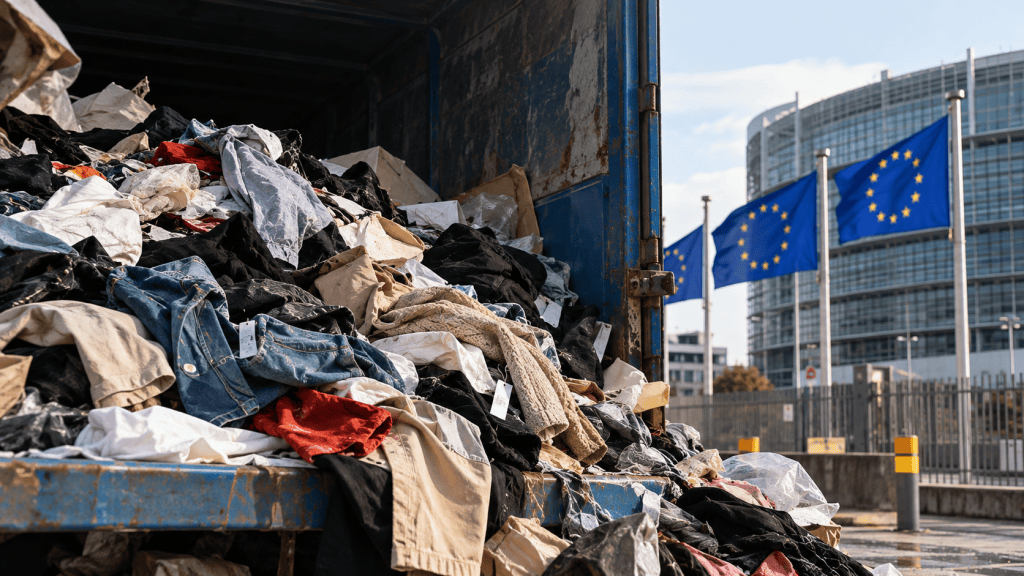
For twenty years, the industry’s answer to the question of what happens to the clothes nobody buys was a shrug and a shredder. Burberry’s incinerated stock made headlines in 2018 and then the conversation moved on, as it always does. What changed this summer is not the industry’s conscience. It is the law.
Since 19 July 2026, large companies across the European Union are prohibited from destroying unsold clothing, clothing accessories and footwear. It is the first concrete obligation to bite under the Ecodesign for Sustainable Products Regulation, and textiles were chosen to go first precisely because of how the sector behaves. I want to be exact about what this does and does not do, because the gap between the two is where the real story sits.
What Actually Changed on 19 July
The rule sits in Article 25 of Regulation (EU) 2024/1781, with the covered product categories listed in Annex VII. It applies to large enterprises now and to medium-sized ones from 19 July 2030. Micro and small companies are outside it altogether.
Three details matter more than the headline.
- Destruction is defined broadly. Shredding unsold jackets to recover fibre counts as destruction. A brand cannot relabel incineration as recycling and call the problem solved.
- Consumer returns are in scope. The quiet disposal route that e-commerce growth made routine, the returned parcel that is cheaper to bin than to re-process, is now covered by the same prohibition.
- The exemptions require proof. Destruction is permitted where items are unsafe or damaged, where they are counterfeit or infringe intellectual property, or where charities and donation schemes have refused them. A company relying on any of these must produce documentation or test results, publish annual reports on what it discarded, and keep records for five years. National authorities inspect, and they can fine.
Before destruction can even be considered, companies are expected to have tried to keep the product in use: sell it, including at a discount or through alternative markets; donate it; or repair, refurbish or remanufacture it. Only then, and only within the waste hierarchy, does disposal become lawful.
This is a well-constructed piece of law. It closes the obvious loopholes and it demands evidence rather than assurances. But read it again and notice what it governs: the final metre of a garment’s life. Nothing in it limits how many garments are made.
The Figure Everyone Repeats, and the One That Holds Up
You will have seen the claim that 30 per cent of the world’s clothing is never sold. It appears in conference decks, campaign literature and, increasingly, in coverage of this very regulation. It is worth knowing where it comes from: a 2018 estimate attributed to the Australasian Circular Textile Association, circulated through an industry infographic and repeated ever since. It describes garments that never find a buyer. It does not describe garments that are destroyed, and the two are not the same thing.
The figure that survives scrutiny comes from the European Environment Agency, in its 2024 briefing on returned and unsold textiles. Between 4 and 9 per cent of all textile products placed on the European market are destroyed before anyone wears them, somewhere between 264,000 and 594,000 tonnes a year. The Commission cited exactly this range when the ban came into force.
I am not making a pedant’s point. A range of 4 to 9 per cent is itself an admission of ignorance, more than double at the top end, and that ignorance is manufactured. Fashion Revolution’s 2023 Transparency Index found that 88 per cent of major fashion brands do not disclose their annual production volumes at all. We are arguing over a trade-association estimate from 2018 because the companies holding the real figures have never been required to publish them.
That is beginning to change, and it is the underrated half of this legislation. A separate disclosure obligation under Article 25 has applied to large companies since 19 July 2025, covering all categories of consumer products: how many unsold items were discarded, by weight and count, why, and by which treatment route. A standardised reporting format follows from March 2027. Within a few years we will no longer be estimating. We will be reading.
The scandal was never only that brands burned clothes. It was that nobody outside the building could say how many.
One Rule Tightened. Another Was Quietly Loosened.
Anyone reading this as a story of Europe steadily ratcheting up pressure on fashion has only half the picture. In the same year the destruction ban took effect, Brussels substantially rolled back its corporate sustainability framework.
The Omnibus I Directive, published as Directive (EU) 2026/470 and in force since 18 March 2026, raised the thresholds for the Corporate Sustainability Due Diligence Directive to more than 5,000 employees and €1.5 billion in net worldwide turnover. Analyses of the final text put the reduction in the number of companies caught by the CSDDD at roughly 70 per cent. In-depth assessment of adverse impacts was narrowed largely to direct suppliers, and the deadline for Member States to transpose the changes was pushed to July 2028.
So the supply-chain due diligence that would have asked a brand to account for conditions at the factories making its clothes was softened and delayed. The rule about what happens to those clothes when they do not sell was not. Pressure did not increase in 2026. It moved.
And it moved in a direction worth understanding. Reporting obligations are negotiable. They are drafted in Brussels, lobbied in Brussels, and amended in Brussels. A prohibition attached to physical goods sitting in a European warehouse is a different kind of object. It does not respond to a position paper. The inventory is either there or it is not, and an inspector can count it. Of the two instruments, the one that survived intact is the one that is hardest to argue with.
The Cost Arrives Anyway, Later and Per Item
The destruction ban does not stand alone, and this is where overproduction finally acquires a price tag.
The revised Waste Framework Directive, Directive (EU) 2025/1898, in force since 16 October 2025, makes extended producer responsibility mandatory for textiles and footwear across every Member State. Producers will pay a fee on every product they place on the market, financing collection, sorting, reuse and recycling. Member States have 20 months to transpose it and 30 to get the schemes running. Fees are eco-modulated, meaning the charge varies with the product’s environmental characteristics, and the directive invites Member States to weigh sales volume when setting contributions.
France has gone further and faster. Its anti-fast-fashion law, adopted by Parliament on 29 June 2026 and promulgated on 8 July, targets what the text calls mode ultra express with an escalating per-item levy rising toward €10 a garment by 2030 and, from 1 January 2027, a ban on advertising those products, influencer promotion included. The law never names Shein, Temu or AliExpress, but nobody is confused about the target, and the drafting deliberately spares European operators such as Zara and H&M. Whether the advertising provisions survive contact with EU e-commerce law is still being argued. That fight is not over.
Taken together, the arithmetic of the business model is being rewritten. Producing a garment now carries a fee at the front end. Failing to sell it carries a disposal problem at the back end, with documentation, publication and inspection attached. The comfortable middle, make far too much, discount hard, quietly destroy the remainder, write it off, is being closed from both directions.
The Only Compliance Strategy That Is Not a Workaround
Watch what the industry does next and you will see most of the energy going into logistics. Secondary markets. Discount channels. Donation partnerships. Refurbishment contracts. All of it legitimate, all of it necessary, and all of it an answer to the wrong question, because every one of those solutions is a way of handling surplus more gracefully. None of them produces less surplus.
Surplus is not an accident of this system. It is a design feature. A brand commits to volume eighteen months before a season on the strength of a forecast, because the factory requires a minimum order quantity to quote a price, and the price has to be low enough to survive the discounting that the volume itself makes inevitable. Overproduction is what you get when the manufacturing model demands a guess and then punishes accuracy.
The structural alternative is not complicated, only unfashionable: short collections, small-batch production with fast reloads, no minimum order quantity, and made to order or made to measure wherever the product allows it. Produce against demand that exists rather than demand that was predicted. The inventory risk does not get managed. It stops being created.
For a brand built that way, 19 July 2026 was not a compliance deadline. It was a Sunday. There is no unsold stock to document, no derogation to evidence, no annual disclosure that reads badly, and when extended producer responsibility fees land on every item placed on the market, they land on a far smaller number of items. The regulation that reads as a cost to one business model reads as a moat around another.
Europe has made the consequences of overproduction expensive. It has not made overproduction illegal. Only a different way of manufacturing can do that.
I welcome this law. It ends a practice that should have been unthinkable and it forces a conversation the industry has avoided for a decade. But I would rather we were honest about its limits than celebrate it as a resolution. A ban on destroying unsold clothes is a statement about waste disposal. The question of why hundreds of thousands of tonnes of new garments arrive each year with nowhere to go remains entirely unanswered, and no regulation currently drafted in Brussels is going to answer it. That one is ours.
Ethical Editorial follows the regulation reshaping how clothes are made in Europe, and the business models that will outlast it. Subscribe to receive each new piece.

Leave a Reply