
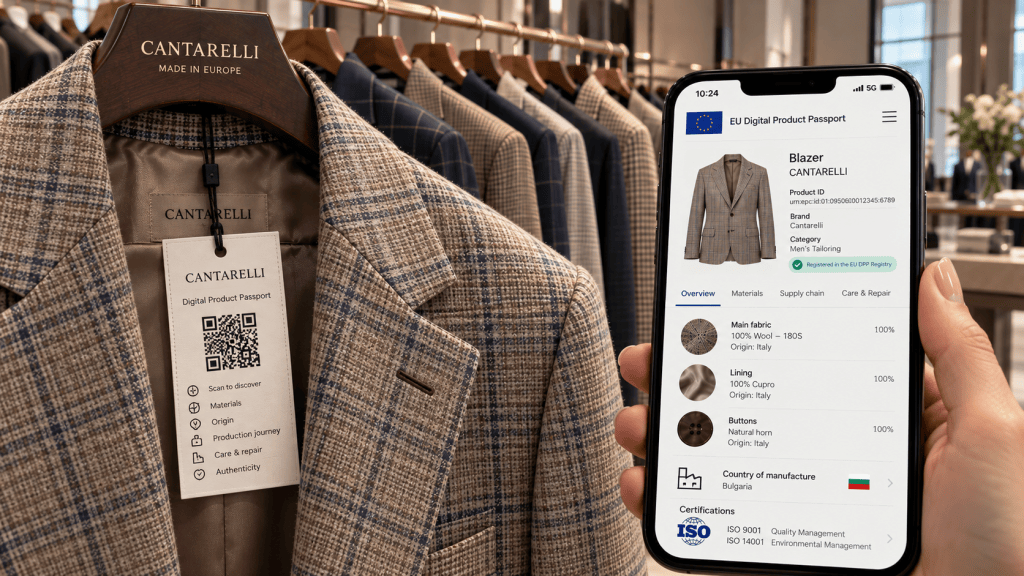
A dress walked a London runway with a code printed on its care label. Scan it and you were given the fibres, the makers, the recovered dyes, the story of the designer’s grandmother. The press called it the future of fashion.
From where I sit, in a factory, with the supplier files open, I saw something less romantic and considerably more interesting. I saw a brand that already knew the answers.
That is the entire story of the Digital Product Passport, and almost nobody is telling it correctly. It is not a technology problem. It is a knowledge problem. And most of this industry does not know.
The Registry Went Live, and Fashion Barely Looked Up
On 20 July 2026, the European Commission switched on the Digital Product Passport Registry together with a testing environment. Established under the Ecodesign for Sustainable Products Regulation, it is the central system in which every passport must be registered before a covered product is placed on the EU market.
The architecture matters more than the announcement. Product data itself stays decentralised, held by the company rather than by Brussels. What the Registry holds is the unique product identifier and the metadata that lets an inspector, a customs officer or a resale platform find that data and verify it. Companies register through a secure interface or an API, and can request proof of registration as a secure electronic document to show partners.
The first binding deadline, 18 February 2027, applies to certain large batteries. Not clothing. Textiles sit in the first wave of the ESPR Working Plan 2025 to 2030, which named apparel a priority product group. The delegated act defining what a garment’s passport must actually contain is expected in 2027, with requirements applying from around 2028.
So: not yet mandatory for fashion. Already built. That gap is the most valuable eighteen months this industry is going to be given, and it is being spent mostly on press releases.
What Patrick McDowell Actually Did, and What He Did Not
The dress was McDowell’s. His Lancashire Rose collection, shown at London Fashion Week in tribute to the grandmother who taught him to sew, gave every look a digital product passport built with the Italian authentication company Certilogo, reached by a code on the garment’s label. He worked with DyeRecycle on recovered textile dyes and with Circ on regenerated fibre.
It is worth being exact here, because the secondhand reporting has not been. There were no microchips woven into the cloth. There was a printed code pointing at a database that somebody had to fill in, line by line, in advance. The theatre was minimal. The work was all upstream, months before anyone saw a garment.
He is neither alone nor first. Chloé began embedding NFC tags and QR codes in 2023 under Chloé Vertical, built with the digital ID company EON and tied to resale through Vestiaire Collective. The Aura Blockchain Consortium, founded in 2021 by LVMH, Prada Group, OTB and Cartier, has registered more than fifty million luxury products across over fifty member brands. At the other end of the market, London’s Nobody’s Child has run passports since 2023 and now covers 112 styles with more than 20,000 customer scans, drawing data from ten suppliers. Tesco has trialled the same underlying technology on its F&F clothing.
Luxury houses, a high-street supermarket and an independent designer arrived at the same place by different roads. That should tell you this is not a trend. It is a floor.
A Passport Only Proves What Someone Was Willing to Write Into It
Jody Plows, who runs Nobody’s Child, has described the real constraint to Vogue Business without any decoration: roughly 110 data points per product. Not per collection. Per product.
Sit with that. A brand running several thousand styles through a supply chain it does not own, three or four tiers deep, where the mill subcontracts the dyeing and the dyehouse subcontracts the finishing. Every one of those fields has to be supplied by somebody who has a commercial incentive to round it in their own favour, and no realistic prospect of being checked.
Then there is what the passport does not contain at all. It describes the product. It does not describe the conditions. There is no field for what the woman at the sewing machine was paid, or how many hours she worked to earn it.
That was meant to be handled elsewhere, by the Corporate Sustainability Due Diligence Directive. In February 2026 the EU adopted the Omnibus I package, which cut that directive back substantially and pushed national transposition out to July 2028. Legal analysts at ClientEarth and Frank Bold noted that the narrowed scope leaves significant parts of high-risk sectors, textiles among them, outside it.
Name the trajectory honestly, because it is strange. Europe is building excellent infrastructure for tracing a fibre at precisely the moment it is retreating from tracing a wage. We are about to know more about the polyester than about the person who stitched it.
Why Short-Series Makers Will Find This Easy, and Volume Will Not
A passport is only as difficult as your supply chain is long.
A made-to-order producer working with a short, named chain of European suppliers already holds almost all of those hundred-odd fields, not because they invested in software, but because a human being physically chose that cloth and signed off that work. For them, compliance is a reporting exercise. For a brand placing an order of 300,000 units eighteen months ahead of a season, through an agent who will not disclose the factory, compliance is an excavation.
This is why I keep insisting that overproduction is not one problem among several. It is the root. The same structure that produces unsold inventory, panic discounting and incineration is the structure that makes traceability nearly impossible, because within it nobody is accountable for any individual garment. It was never made for anyone in particular.
Made to measure and made to order, short collections, fast small-batch reloads, no minimum order quantities: these exist to remove inventory risk and allow honest pricing. The Digital Product Passport reveals a second dividend nobody designed them for. A supply chain built this way can answer questions. It has always been able to answer questions. It simply was not asked before.
If you manufacture or build a brand and you are reading this in 2026, the strategic position is not complicated. The companies that find 2028 painless will be the ones assembling supplier data this season, while it is still voluntary and nobody is auditing it. The companies that wait for the delegated act to be published will be trying to reconstruct the history of garments that have already been made, from suppliers who have no obligation to remember.
Transparency Is Not a Feature. It Is a Consequence.
For twenty years this industry has treated transparency as communication: a page on a website, a badge, a paragraph in a sustainability report, written by people who have never stood on a production floor. The Digital Product Passport ends that arrangement. Not because it is moral, but because it is machine-readable. A claim that can be compared across ten thousand products by a regulator, a resale platform or a competitor is a fundamentally different kind of claim from a sentence in a brochure.
What it cannot do is make a bad garment good. A passport attached to a polyester dress engineered to survive two months will document, in beautiful and verifiable detail, a waste of everyone’s time and the planet’s resources. Traceability is not a substitute for worth. It is only a way of proving whether worth was ever there.
The passport is a mirror. It is going to show this industry exactly what it has been doing, at the level of the individual garment, to anyone holding a phone. Some brands are right to be frightened of that. The ones who built properly have been waiting for it.
Traceability is not something you add to a garment. It is something you either had all along, or have to invent afterwards.
Ethical Editorial follows the regulation reshaping how clothes are made in Europe. Subscribe to receive each new piece.

Leave a Reply