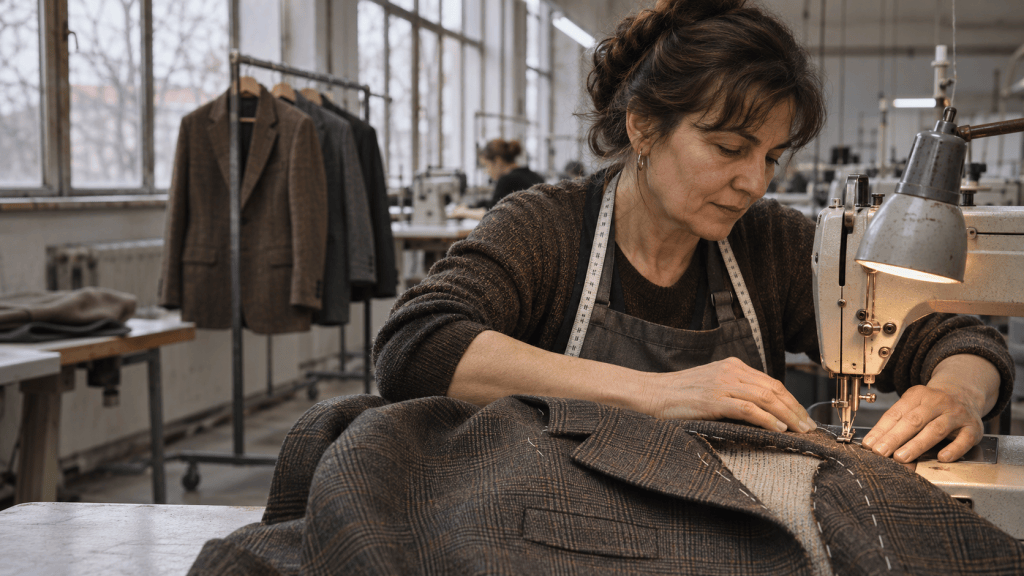
Picture a wool jacket in a Paris boutique. The tag says €600. The story says “designed in France.” The seams, very possibly, were sewn in a Bulgarian town most customers couldn’t find on a map.
Europe’s quiet workshop
Bulgaria has been stitching for Western fashion for decades. Bulgarian media coverage, such as a recent feature republished by Novini 24/7, links the country to Armani, Hugo Boss, Zegna, Max Mara, Burberry, Givenchy and Lacoste. Some of those partnerships are historical, and not every one is confirmed as current. Others are on record: Sézane and Sessùn both name Bulgaria among their production countries, and Sandro works with around 140 sites in about 30 countries, Bulgaria included.
The pattern is always the same. Design and first samples happen in Paris or Milan. Production goes to specialist factories, such as Pirin-Tex in Gotse Delchev, long tied to Hugo Boss, or Dimitrov in Pleven, a menswear tailoring house. The label shows the brand. The factory stays invisible.
The price gap nobody prints on the label
Here is the uncomfortable part. A 2021 Deutsche Welle report found that seamstresses are paid roughly the same whether a jacket retails at €80 or €800. One investor in the Sliven area put his company’s average monthly salary at €500–600. In villages near the Greek border, women hoped for about €300. The Clean Clothes Campaign has also documented minimum-wage violations and unpaid overtime in the sector. The figures are a few years old, but the logic they expose has not changed: the price of the garment and the pay of the person who made it are two separate conversations.
Now the factories are squeezed too
Bulgarian manufacturers face a shortage of workers, rising costs and fierce competition from Asia and North Africa. Some foreign buyers move orders wherever labor is cheaper. Factories are asked to deliver top quality at a competitive price, on tight timelines, for orders that can disappear next season.
The problem is the model, not the map
I don’t think the answer is to boycott “made in Bulgaria.” Skilled European factories are exactly what ethical fashion needs. The problem is the system around them: huge speculative orders, minimum quantities, price pressure, and collections built to be marked down. When a brand must sell thousands of units to justify an order, someone downstream absorbs the risk. Usually it is the factory, and then the worker.
Overproduction is the root of it. Made-to-measure, made-to-order and short-series production flip the logic: make what is actually sold, reload fast in small batches, carry no unsold stock. With no inventory risk to pass down the chain, fair pricing stops being charity and becomes arithmetic.
Three questions worth asking any brand
- Where exactly is this made, and can you name the factory?
- How are production volumes decided: by real demand or by a forecast?
- What share of the retail price reaches the people who sewed it?
A brand that answers these confidently has nothing to hide. One that goes quiet has told you what you needed to know. Luxury is supposed to mean care at every stage. It’s time the seams were part of the story.

Leave a Reply